Home | MyGov

Accessibility
Accessibility Tools
Color Adjustment
Text Size
Navigation Adjustment
Screen Reader iconScreen Reader

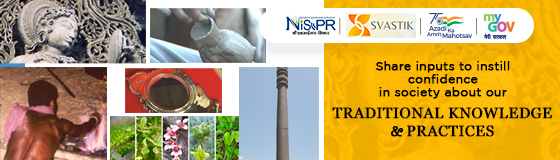
Share inputs to instil confidence in society about our traditional knowledge and practices

Share inputs to instil confidence in society about our traditional knowledge and practices
Start Date :
Mar 03, 2022
Last Date :
Aug 31, 2022
23:45 PM IST (GMT +5.30 Hrs)
Submission Closed

India has a rich legacy of practices and knowledge touching different spheres of life and a scientific heritage traversing various Science & Technology (S&T) domains. The ...

India has a rich legacy of practices and knowledge touching different spheres of life and a scientific heritage traversing various Science & Technology (S&T) domains. The traditional knowledge of India is available in various forms such as classical texts, manuscripts and/or as oral communication that has been passed on over thousands of years. This valuable knowledge is often part of our daily practices as well. Some of the traditional practices are livelihood means of the concerned knowledge holders. Our traditional practices exist in synergy between human needs and nature, often balancing resources and requirements in a local context. However, with time, India’s Traditional Knowledge Systems are eroding rapidly, and the nation has also been witnessing erosion in people’s faith towards our traditional knowledge. A grave concern is the mindless attitude of some to mimic non-Indian cultures and disdain for our traditions. It’s important to recognize that traditional heritage is an integral part of any country’s development and progression. This calls for necessary attention and action from the concerned stakeholders in the country to build further on our scientific inheritance. Only a well-informed and balanced society can drive the advancement of the country.

Under the visionary leadership of our Hon’ble Prime Minister and President, CSIR Society, Shri Narendra Modi, the Council of Scientific and Industrial Research (CSIR) is spearheading the efforts to collaborate with the relevant partners from across the country and implement the national initiative SVASTIK (Scientifically Validated Societal Traditional Knowledge) for communicating India’s traditional knowledge to the society. CSIR-National Institute of Science Communication and Policy Research (CSIR-NIScPR) is the nodal organization to implement this national initiative.

The prime mission of the initiative is to conserve scientifically validated traditional practices, and instil confidence in citizens regarding the scientific values of our traditional knowledge/practices.

We invite the suggestions of academicians, researchers, subject-matter experts, students, NGOs, and the public on how to instil confidence in society about our traditional knowledge and practices. This will help us in our mission to inculcate a scientific temper and instil confidence in citizens by stimulating the Science-Scientist-Society connect towards our traditional knowledge and practices.

Click here to read more about the SVASTIK Initiative of CSIR-NIScPR. (PDF 1519 KB)
Or visit the website - https://niscpr.res.in/nationalmission/svastik

How much are you aware of our traditional knowledge and practices? Participate in MyGov quiz and check your awareness of the traditional knowledge of India. Quiz Link: https://quiz.mygov.in/quiz/quiz-on-indian-traditional-knowledge/

The last date to share your ideas and suggestions is 31st August 2022.

Reset
Showing 2022 Submission(s)
Vikram singh Tomar
Vikram singh Tomar 3 years 10 months ago
Traditional Knowledge Systems or Indigenous Knowledge Systems are a body of knowledge, which is very ancient and deep rooted. They have their origins in the remote past. Their systematisation and canonisation gave rise to the elite (the Greater Tradition) science. We all realise the importance of this ancient knowledge and technology, which incorporates the wisdom distilled through millennia of experimentation and trial and error. The nature of Traditional Knowledge System (TKS) is diverse. It covers, among other things, literary, artistic and scientific works; songs, dances, medical treatments and practices; and agricultural technologies and techniques. There is a dramatically growing national and international interest in incorporating Traditional Knowledge Systems, including Traditional Ecological Knowledge, into truly participatory approaches to development. The international community has sought to recognize and protect TKS only recently. In 1981, WIPO and UNES
mygov_1660366105114125
anil kumar sharma
anil kumar sharma 3 years 10 months ago
The scientifically rich heritage of all civilization is the Snatan Parmpara. The biggest source of scientific researches are Vedas and adjacent texts .The mode of calculation of time to lowest units,the secret of Universe which the researchers are projecting today was disclosed with perfection in these old credentials of Snatan Dharma.Hiw aware they were when talk of ecological balance .Worship of trees and extraction of chemicals for treatment of diseases and made the whole system of medicine Ayurveda.Swachh Bharat Mission which is being propounded now a days with its significance is only due to our of mind our set up ethics ,where we treat our rivers in no way less than our Mother.This soul of earth our mother land .We have destroyed our heritage and legacies but now doing damage control.How can we keep ourselves healthy Yogic Kriya given by our Ancestor ,making the modern demos awakened of its health benefits.Time to incarnate the legacies for survival of biosphere is the need
AbhishekDutta
AbhishekDutta 3 years 10 months ago
The government can create short animated educational videos which will highlight our traditional practices and the science behind them to make those practices much more convincing to the present society. Every traditional value has a scientific aspect behind it but somehow we don’t talk about the science and we only preach “do this”, “ do that” which sometimes people tend to think as superficial and superstition. Therefore highlighting the science is important. These short videos can then be released in social media platforms or mass consumption.
Sathiyavani
Sathiyavani 3 years 10 months ago
Traditional knowledge is also carried in digital records (e.g. e-books, catalogues, datasets etc) giving rise to issues of data sovereignty.skills and practices that are developed, sustained and passed on from generation to generation within a community, often forming part of its cultural or spiritual identity.
Nikithaa Suresh
Nikithaa Suresh 3 years 10 months ago
As a student of KTPI (Knowledge Traditions and Practices of India), I feel much obliged to share my views on this topic. When one hears about the word tradition, he just thinks about going to temple and offering prayers. What about our ancient scriptures and texts? What about our ancient astrology, astronomy, chemistry, agriculture, music, dance and what not? One must understand the significance of learning scriptures like Vedas and Puranas, following ancient practices etc. These texts help us to understand our nation's rooted culture and how to pass it on to future generations. We shouldn't allow western culture to modify us. If this continues even the petrichor of soil will be sold as a perfume fragrance in future. People should try to adapt olden practices, scriptures and KTPI should be made as mandatory in syllabus, NEP must be promoted etc. In this generation of chatting with your loved ones daily and meeting them once in a blue moon, one forgets to connect with heart .
Shivang Dixit
Shivang Dixit 3 years 10 months ago
ભારતીય પાસે તેનું પોતાનું સોશિયલ મીડિયા ન હોવું જોઈએ અથવા વિશ્વના સોશિયલ મીડિયા પ્લેટફોર્મમાં/ઓ પર તેના પોતાના એકાઉન્ટ્સ ન હોવા જોઈએ આ તમામ ડેટાબેઝ લીક થઈ શકે છે અને આતંકવાદ જેવી સંસ્થા કોઈપણ સરકારી સિસ્ટમ માટે છટકબારીઓ વિકસાવી શકે છે સાવચેતી માટે કૃપા કરીને અમારી ભારત સરકારનું પોતાનું સોશિયલ મીડિયા બનાવો. ફક્ત અમારા સુપર કોમ્પ્યુટર આધારિત સિસ્ટમ પ્રોગ્રામિંગ સ્તરો કૃપા કરીને આ પડકાર મૂલ્યાંકનને પ્રામાણિકતા પ્રદાન કરો કારણ કે તમે વિશ્વાસપાત્ર આત્મા છો
Anagha Jayan
Anagha Jayan 3 years 10 months ago
India is recognised as a country that values tradition. The schools , the government should take steps to prevent the loss of our tradition. Government could bring in schemes and other measures to protect the livelihood of people who does traditional work such as weaving , pottery , cultivation etc. The schools and colleges could teach students the importance of the same and take measures to protect the same
NIKITASHASINGH
NIKITASHASINGH 3 years 10 months ago
Great civilizations have long been known to have developed alongside rivers. Water availability determines the flora-fauna, climate, agriculture and economy of any geographic terrain. Traditionally, India has been home to magnificent concepts and practices of water harvesting and water conservation in its different regions. Today, the country has progressed technologically to become the third largest economy in the world. However, it is observed that with the techno-advancement, people are drifting away from the rich traditional wisdom of water conservation. The indigenous concept of Man- Nature- Religion was practiced to protect Mother Nature. (Eg: Removing footwear at a small Deity platform before stepping into any water sources; Worshipping Trees, etc). In this context, modern urban planning could be combined with region-specific indigenous knowledge of water harvesting and water conservation like Taalab, Khadin, Tanka, etc. to sustain water resources and replenish groundwater.
Mukesh Kumar Maurya
Mukesh Kumar Maurya 3 years 10 months ago
Great civilizations have long been known to have developed alongside rivers. Water availability determines the flora-fauna, climate, agriculture and economy of any geographic terrain. Traditionally, India has been home to magnificent concepts and practices of water harvesting and water conservation in its different regions. Today, the country has progressed technologically to become the third largest economy in the world. However, it is observed that with the techno-advancement, people are drifting away from the rich traditional wisdom of water conservation. The indigenous concept of Man- Nature- Religion was practiced to protect Mother Nature. (Eg: Removing footwear at a small Deity platform before stepping into any water sources; Worshipping Trees, etc). In this context, modern urban planning could be combined with region-specific indigenous knowledge of water harvesting and water conservation like Taalab, Khadin, Tanka, etc. to sustain water resources and replenish groundwater.
kalpana sharma
kalpana sharma 3 years 10 months ago
Entire Scriptures must be introduced in curriculum to instill traditional beliefs/ Values in the current Every school must be forced to adopt GURUKULAM.