Home | MyGov

Accessibility
Accessibility Tools
Color Adjustment
Text Size
Navigation Adjustment
Screen Reader iconScreen Reader

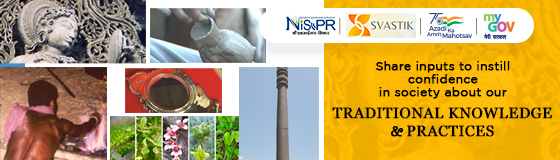
Share inputs to instil confidence in society about our traditional knowledge and practices

Share inputs to instil confidence in society about our traditional knowledge and practices
Start Date :
Mar 03, 2022
Last Date :
Aug 31, 2022
23:45 PM IST (GMT +5.30 Hrs)
Submission Closed

India has a rich legacy of practices and knowledge touching different spheres of life and a scientific heritage traversing various Science & Technology (S&T) domains. The ...

India has a rich legacy of practices and knowledge touching different spheres of life and a scientific heritage traversing various Science & Technology (S&T) domains. The traditional knowledge of India is available in various forms such as classical texts, manuscripts and/or as oral communication that has been passed on over thousands of years. This valuable knowledge is often part of our daily practices as well. Some of the traditional practices are livelihood means of the concerned knowledge holders. Our traditional practices exist in synergy between human needs and nature, often balancing resources and requirements in a local context. However, with time, India’s Traditional Knowledge Systems are eroding rapidly, and the nation has also been witnessing erosion in people’s faith towards our traditional knowledge. A grave concern is the mindless attitude of some to mimic non-Indian cultures and disdain for our traditions. It’s important to recognize that traditional heritage is an integral part of any country’s development and progression. This calls for necessary attention and action from the concerned stakeholders in the country to build further on our scientific inheritance. Only a well-informed and balanced society can drive the advancement of the country.

Under the visionary leadership of our Hon’ble Prime Minister and President, CSIR Society, Shri Narendra Modi, the Council of Scientific and Industrial Research (CSIR) is spearheading the efforts to collaborate with the relevant partners from across the country and implement the national initiative SVASTIK (Scientifically Validated Societal Traditional Knowledge) for communicating India’s traditional knowledge to the society. CSIR-National Institute of Science Communication and Policy Research (CSIR-NIScPR) is the nodal organization to implement this national initiative.

The prime mission of the initiative is to conserve scientifically validated traditional practices, and instil confidence in citizens regarding the scientific values of our traditional knowledge/practices.

We invite the suggestions of academicians, researchers, subject-matter experts, students, NGOs, and the public on how to instil confidence in society about our traditional knowledge and practices. This will help us in our mission to inculcate a scientific temper and instil confidence in citizens by stimulating the Science-Scientist-Society connect towards our traditional knowledge and practices.

Click here to read more about the SVASTIK Initiative of CSIR-NIScPR. (PDF 1519 KB)
Or visit the website - https://niscpr.res.in/nationalmission/svastik

How much are you aware of our traditional knowledge and practices? Participate in MyGov quiz and check your awareness of the traditional knowledge of India. Quiz Link: https://quiz.mygov.in/quiz/quiz-on-indian-traditional-knowledge/

The last date to share your ideas and suggestions is 31st August 2022.

Reset
Showing 2022 Submission(s)
Jayadharani
Jayadharani 3 years 10 months ago
Traditional knowledge can be acknowledged by learning moral literature , good books and mainly by elderly person who's persistent in good deeds, I hope if these things are circulated well... it can still uphold the traditional India... for a peace and harmonious future, traditional values are truly appreciate to be followed...
Shivang Dixit
Shivang Dixit 3 years 10 months ago
According to the traditional democratic method, you can give a job of 30 years of research sub-job class according to the employee population of each state, according to the employee's system.
SHARVAN KUMAR PANDEY
SHARVAN KUMAR PANDEY 3 years 10 months ago
समाज में समाज के प्रति सभी के प्रति सम्मान एवं निस्वार्थ भाव से सेवा समाज में अच्छा योगदान है
JOSEPH KALLIKATTU ANTONY
JOSEPH KALLIKATTU ANTONY 3 years 10 months ago
Sir, Traditional knowledge is one of the great treasures of India. In order to popularise our traditional knowledge and practices, the following steps are suggested: 1. Our important traditional knowledge and practices are to be included in the curriculum of all classes- Standard 1 to 12. 2. Best traditional practices of the country are to be given wide publicity through electronic media and social media. 3. The effectiveness of medicinal plants like Tulsi, Turmeric, Black pepper, Cardamom, Garlic, Clove, Nut Meg, Aloe Vera etc are to be popularised through a mass campaign. 4. Financial and supportive incentives are to be offered to those farmers and small enterprises for the cultivation and processing of medicinal plants. 5. People are to be encouraged to purchase the locally made items such as Bamboo furniture, bamboo baskets, earthen pots and cookwares, loally made toys etc. 6. Our traditional festivals and local art forms are to be passed on to younger generations.
Parmar Smit
Parmar Smit 3 years 10 months ago
Elders are known to be storehouse of traditional values, skills and morale. Present paper is an attempt to discuss the traditional knowledge of elderly people, their role and highlights many areas where it can be useful for elderly themselves. Some insights are offered for strategic utilization of traditional knowledge and experience of elderly to address the need and improve the quality of elderly life in terms of socio-psychological, cultural, economic and health aspects. This valuable traditional information can be made accessible, affordable and adaptable to the specific needs of elderly people. Presently, the loss of biological diversity and erosion of traditional knowledge systems (TKS) are issues of great concern. Most of these systems of knowledge are unique and are often known only to a few individuals or communities. This traditional knowledge includes mental inventories of local biological resources, animal breeds, local plant, and crop and tree species. Traditional knowledg
Revathi M
Revathi M 3 years 10 months ago
Good morning 💥Modi sir *Increase women safety rules *proceed rules act for after 21 years Marriage for girls *Predictive effective rules against repist
Rajesh Chourasia
Rajesh Chourasia 3 years 10 months ago
रक्षाबंधन के पावन पर्व की हार्दिक शुभकामनाएं बधाई
Shivang Dixit
Shivang Dixit 3 years 10 months ago
सरकारी विकास खजाना निधि जहां नागरिक कर मुक्त लाभ ले सकते हैं और साथ ही वे अपनी आय का उपयोग अपनी जाति समुदाय बुनियादी ढांचा योजना के लिए कर सकते हैं और उनके घरेलू खर्च उनकी सामाजिक सुरक्षा प्रणाली और नागरिकों के लिए बीमा प्रणाली के लिए सामाजिक न्याय प्रणाली के सुरक्षा लाभों के लिए पात्र हैं।
GIRISH BHARAT JABADE
GIRISH BHARAT JABADE 3 years 10 months ago
जब हम छोटे थे तब हमारे स्कूल के अभ्यासक्रम में मराठी में आजीचा बटवा करके ,प्रथमोपचार करके कही सारे बुक्स हुवा करते थे उसमे अगर आपको चोट लगे ,बिच्छू कटले या सांप कटले तो पहले क्या कारन चाहिए उसकी जानकारी होतीथी। उससे बहुत सारा पारंपरिक ज्ञान मिलता था। अभी वो किसी भी स्कूल के पाठ्यक्रम नहीं हे। में ये अनुरोध ऐसे बहुतसी पारंपरिक ज्ञान स्कूल के पाठ्यक्रम में फिरसे शामिल करना चाहिए उससे हमारे उस पारंपरिक ज्ञान संरक्षण भी जायेगा। नए आनेवाले पीडियोमे उसका पहुंच जायेगा और उसका वो अपने जीवनमे उपयोग कर सकेंगे। धन्यवाद।