

Home | MyGov

Accessibility
ऐक्सेसिबिलिटी टूल
कलर एडजस्टमेंट
टेक्स्ट साइज़
नेविगेशन एडजस्टमेंट

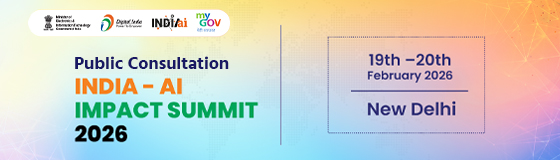
Public Consultation - Help Shape the AI Impact Summit 2026

Public Consultation - Help Shape the AI Impact Summit 2026
आरंभ करने की तिथि :
Jun 06, 2025
अंतिम तिथि :
Jun 30, 2025
17:45 PM IST (GMT +5.30 Hrs)
प्रस्तुतियाँ समाप्त हो चुके

India is proud to host the AI Impact Summit 2026, a landmark global event announced by the Hon’ble Prime Minister at the France AI Action Summit. Building on the momentum of ...

India is proud to host the AI Impact Summit 2026, a landmark global event announced by the Hon’ble Prime Minister at the France AI Action Summit. Building on the momentum of Bletchley Park, Seoul, and Paris, the Summit will mark a strategic shift, from action to measurable impact, in global AI cooperation.

The Summit envisions a future where AI delivers real impact, advancing inclusive growth, social development, and a healthier planet. It aims to ensure that AI innovation and governance reflect the diverse realities, languages, and development priorities of both emerging and advanced economies.

Bringing together governments, industry leaders, researchers, startups, civil society, and international organizations, the Summit will chart a shared vision for harnessing AI responsibly, for good, and for all. The Summit will help bridge the AI divide and enable all communities, especially in the developing world, to shape and benefit from the future of AI.

To ensure the Summit is grounded in public priorities and stakeholder insight, the Government of India invites inputs from citizens, students, researchers, startups, civil society, and domain experts. Your feedback will help shape the themes, focus areas, and key deliverables of the Summit.

The Ministry of Electronics and Information Technology (MeitY), through IndiaAI (an independent Business Division under the Digital India Corporation), in collaboration with MyGov, is inviting inputs to help shape the discourse, themes, and outcomes of the AI Impact Summit 2026. Your views will ensure the Summit reflects national and international priorities and delivers meaningful, inclusive, and actionable outcomes.

Please provide your suggestions and inputs below regarding the AI Impact Summit and its themes, outcomes, priorities, and more

फिर से कायम कर देना
645 सबमिशन दिखा रहा है
SANJAY SARKAR
SANJAY SARKAR 1 year 2 सप्ताह पहले
Adoption Across Sectors: AI adoption is growing in India across different sectors due to initiatives like the National AI Strategy and the National AI Portal launched by the Government of India. Sectors like healthcare, finance, retail, manufacturing, and agriculture are rapidly integrating AI technologies. Focus on Data Analytics: Clive Humby's assertion that "data is the new oil" underscores the growing importance of AI-driven data analytics. Companies are leveraging AI-driven analytics to gain valuable insights, improve operations, and foster innovation, supported by initiatives like the AI for All program launched by National Association of Software and Service Companies (NASSCOM). Government Initiatives: Initiatives like Digital India, Make in India, and Smart Cities Mission, GI Cloud (MeghRaj) and Global INDIAai Summit hosted by India are driving AI adoption across sectors. Research and Development: Indian research institutions and academic organizations, such as IITs, ISI,
SANJAY SARKAR
SANJAY SARKAR 1 year 2 सप्ताह पहले
IndiaAI Compute Capacity: Creation of a high-end AI computing ecosystem with over 10,000 Graphics Processing Units (GPUs) to support AI startups and research, along with an AI marketplace for resources. IndiaAI Innovation Centre: Development of indigenous Large Multimodal Models (LMMs) and foundational models for various sectors. Close to Rs 2,000 crore has been earmarked for this centre IndiaAI Datasets Platform: A unified platform to provide seamless access to quality non-personal datasets for startups and researchers. IndiaAI Application Development Initiative: Promotion of AI applications targeting problem statements from various governmental sectors, aiming for large-scale socio-economic transformation. IndiaAI FutureSkills: Expansion of AI education through undergraduate, master’s, and Ph.D. programs, as well as establishing Data and AI Labs in smaller cities. IndiaAI Startup Financing: Provision of streamlined funding access for deep-tech AI startups to support innovative projec
SANJAY SARKAR
SANJAY SARKAR 1 year 2 सप्ताह पहले
The mission aims to establish a robust AI computing infrastructure in India to support the development and testing of AI systems. The Mission aims to enhance data quality, and develop indigenous AI technologies. It focuses on attracting top talent, fostering industry collaboration, supporting impactful AI startups, and promoting ethical AI practices. Financial Support: The Union Cabinet approved the Rs 10,372 crore IndiaAI Mission in March to establish a computing capacity of over 10,000 GPUs and develop foundational models with a capacity of more than 100 billion parameters trained on datasets covering major Indian languages for priority sectors like healthcare, agriculture, and governance. Current Focus: Initial efforts will involve procuring 300 to 500 GPUs to kickstart the project.
SANJAY SARKAR
SANJAY SARKAR 1 year 2 सप्ताह पहले
The Indian government's commitment to advancing artificial intelligence (AI) technology is evident with its new budgetary allocation for the IndiaAI Mission. The Ministry of Electronics and Information Technology has been allocated Rs 551.75 crore in the Union Budget 2024-25 to enhance AI infrastructure, including the procurement of high-performance Graphic Processing Units (GPUs). This move aims to support domestic AI development and reduce reliance on expensive foreign hardware
RaviRanjanKumar
RaviRanjanKumar 1 year 2 सप्ताह पहले
Honourable PM sir, Artificial Intelligence, particularly ML, can be used to classify rocks and minerals based on petrographic data, such as thin-section images or chemical compositions. Techniques like convolutional neural networks (CNNs) analyze microscopic images to identify mineral textures, structures, and compositions with high accuracy. For example, ML models can automate mineral identification in igneous and metamorphic rocks, reducing human error and time spent on manual petrographic analysis. AI processes large geochemical datasets from techniques like Laser Ablation Inductively Coupled Plasma Mass Spectrometry (LA-ICP-MS), XRF, EPMA etc. ML algorithms identify patterns in trace element distributions, isotopic ratios, and mineral compositions to infer petrogenetic processes, such as magma evolution or ore formation. Yours Sincerely, Ravi
Devang Asthana
Devang Asthana 1 year 2 सप्ताह पहले
The current variants of AI are simply next-word, next-pixel, and next-frame generating algorithms. India should focus on creating our own variant of Artificial Intelligence that can act as more than a glorified version of search engines. We have the minds capable of creating something original and new rather than building on the methods used by every other AI corp because quite frankly, we're rather late in the race already.
KrishnaPrabhu
KrishnaPrabhu 1 year 2 सप्ताह पहले
The power of AI can be used to channalise the human minds. By the means of scrapping the speech of negative and hate from the social media. Some family lost their loved ones to the thought process of the haters. Bhakti and building strong mind and body is the best replacement for the hate and negative thoughts. So I request the nation to devote to the growth of them selves and to the rest of the world.
KrishnaPrabhu
KrishnaPrabhu 1 year 2 सप्ताह पहले
Please help our Tamil Nadu people suffering from cow smuggling. In night time smugglers come in vehicle and catch up the cattle and run away. When We have tried to track the stolen cows, it pointed to Our neighbouring state Kerala. So please support our Tamil Nadu people by stopping the cow smuggling.
Sanjeevani Das
Sanjeevani Das 1 year 2 सप्ताह पहले
Honourable PM Sir, Integrating AI into the justice system, particularly through AI-assisted judgment and automated FIR registration, can revolutionise how justice is delivered in India. AI tools can support judges by analysing case data, identifying precedents, and minimising human bias, speeding up verdicts without replacing human oversight. Simultaneously, AI-driven FIR registration using multilingual chatbots and voice interfaces can make reporting crimes easier, faster, and more accessible to all citizens, especially in rural and low-literacy areas. However, this must be implemented with strict transparency and accountability to prevent misuse and ensure fairness. Empowering the judiciary and law enforcement with AI literacy and ethical frameworks will be crucial to making justice more efficient, equitable, and accessible nationwide. Regards, Sanjeevani Das