With a coastline of nearly 7.5 thousand kilometres, India has a unique maritime position. Nine of its 29 states are coastal, and the nation’s geography includes 1,382 islands. There are nearly 199 ports, including 12 major ports that handle approximately 1,400 million tons of cargo each year. Moreover, India’s Exclusive Economic Zone of over 2 million square kilometres has a bounty of living and non-living resources with significant recoverable resources such as crude oil and natural gas. Also, the coastal economy sustains over 4 million fisherfolk and coastal communities. With these vast maritime interests, the blue economy occupies a vital potential position in India’s economic growth. It could well be the next multiplier of GDP and well-being, provided sustainability and socio-economic welfare are kept centre-stage. Therefore, India's draft blue economy policy is envisaged as a crucial framework towards unlocking country’s potential for economic growth and welfare.
The MoES prepared the draft blue economy policy framework in line with the Government of India’s Vision of New India by 2030. It highlighted the blue economy as one of the ten core dimensions for national growth. The draft policy framework emphasizes policies across several key sectors to achieve holistic growth of India’s economy. The document recognizes the following seven thematic areas.
1.National accounting framework for the blue economy and ocean governance.
2.Coastal marine spatial planning and tourism.
3.Marine fisheries, aquaculture, and fish processing.
4.Manufacturing, emerging industries, trade, technology, services, and skill development.
5.Logistics, infrastructure and shipping, including trans-shipments.
6.Coastal and deep-sea mining and offshore energy.
7.Security, strategic dimensions, and international engagement.
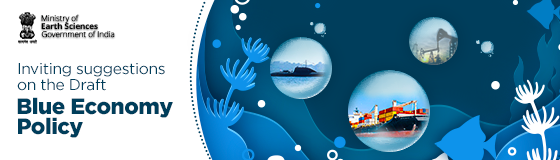
The Ministry of Earth Sciences (MoES) has rolled out the Draft Blue Economy policy for India by Inviting suggestions and inputs from various stakeholders including industry, NGOs, academia, and citizens. The draft blue economy policy document outlines the vision and strategy that can be adopted by the Government of India to utilize the plethora of oceanic resources available in the country.
Click here to read the Draft Blue Economy Policy.