Home | MyGov

Accessibility
ऐक्सेसिबिलिटी टूल
कलर एडजस्टमेंट
टेक्स्ट साइज़
नेविगेशन एडजस्टमेंट

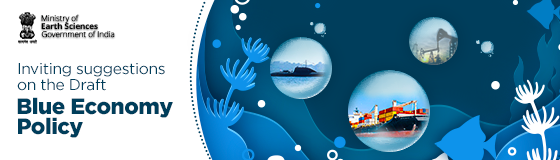
Inviting Suggestions on the Draft Blue Economy Policy

Inviting Suggestions on the Draft Blue Economy Policy
आरंभ करने की तिथि :
Feb 19, 2021
अंतिम तिथि :
Feb 27, 2021
23:45 PM IST (GMT +5.30 Hrs)
प्रस्तुतियाँ समाप्त हो चुके

With a coastline of nearly 7.5 thousand kilometres, India has a unique maritime position. Nine of its 29 states are coastal, and the nation’s geography includes 1,382 islands. ...

With a coastline of nearly 7.5 thousand kilometres, India has a unique maritime position. Nine of its 29 states are coastal, and the nation’s geography includes 1,382 islands. There are nearly 199 ports, including 12 major ports that handle approximately 1,400 million tons of cargo each year. Moreover, India’s Exclusive Economic Zone of over 2 million square kilometres has a bounty of living and non-living resources with significant recoverable resources such as crude oil and natural gas. Also, the coastal economy sustains over 4 million fisherfolk and coastal communities. With these vast maritime interests, the blue economy occupies a vital potential position in India’s economic growth. It could well be the next multiplier of GDP and well-being, provided sustainability and socio-economic welfare are kept centre-stage. Therefore, India's draft blue economy policy is envisaged as a crucial framework towards unlocking country’s potential for economic growth and welfare.

The MoES prepared the draft blue economy policy framework in line with the Government of India’s Vision of New India by 2030. It highlighted the blue economy as one of the ten core dimensions for national growth. The draft policy framework emphasizes policies across several key sectors to achieve holistic growth of India’s economy. The document recognizes the following seven thematic areas.

1.National accounting framework for the blue economy and ocean governance.
2.Coastal marine spatial planning and tourism.
3.Marine fisheries, aquaculture, and fish processing.
4.Manufacturing, emerging industries, trade, technology, services, and skill development.
5.Logistics, infrastructure and shipping, including trans-shipments.
6.Coastal and deep-sea mining and offshore energy.
7.Security, strategic dimensions, and international engagement.

The Ministry of Earth Sciences (MoES) has rolled out the Draft Blue Economy policy for India by Inviting suggestions and inputs from various stakeholders including industry, NGOs, academia, and citizens. The draft blue economy policy document outlines the vision and strategy that can be adopted by the Government of India to utilize the plethora of oceanic resources available in the country.

Click here to read the Draft Blue Economy Policy.

फिर से कायम कर देना
487 सबमिशन दिखा रहा है
DeviS
DeviS 5 साल 4 महीने पहले
The blue economy policy is an great economy change in our nation. We are well known that our country is an peninsular country. Most of our imports and experts are done by sea ports. Which is an major part of our economy.And of course sea/ocean tourism contributes many jobs as well as income. Many costal people's livelihood is depended upon the sea jobs that's is fisheries. There is huge amount of exports of fish in our country. Marine energy plays an vital role in economic development.
NANDAN SHERLEKAR
NANDAN SHERLEKAR 5 साल 4 महीने पहले
Blue economy policy should have total communication corridor on territorial water by having towers with combination of wind mill or solar panels to be self sufficient.We have buoys, small islands at several locations in sea with hazard lamps it means there's a high point in sea. This could be converted to a permanent structure with lights, satallite link, cameras & cellular phone.This can identify all vessels with identification. To some extent weather conditions also can be monitored.
RAJESH MAHATO
RAJESH MAHATO 5 साल 4 महीने पहले
India's blue economy is comprising an entire ocean resources system and human-made economic infrastructure in marine, maritime, and onshore coastal zones within the country's legal jurisdiction.It should aids the production of goods and services that have clear linkages with economic growth, environmental sustainability, and national security. With such a large coastline, we have woken up after so many years to realise its potential.
Palaksharma
Palaksharma 5 साल 4 महीने पहले
The Ministry of Earth Sciences (MoES) has rolled out the Draft Blue Economy policy for India in the public domain inviting suggestions and inputs from various stakeholders including industry, NGOs, academia, and citizens. The draft blue economy policy document outlines the vision and strategy that can be adopted by the Government of India to utilize the plethora of oceanic resources available in the country. The policy document has been disseminated for pubic consultation on several outreach pla
Rudresha N
Rudresha N 5 साल 4 महीने पहले
In costal areas of Karnataka we have wonderful waterfalls like kosalli falls, jadekal falls, bangarakusuma falls, seeta falls etc with wast forest vegetation, very less people have saw these places tourism department not that much active in our state, kindly do intimate tourism team of Karnataka to make these places as accessible for people because these are in canopy of forest. Due to this the revenue of local people will increase and tourism department can also make profit