Home | MyGov

Accessibility
ऐक्सेसिबिलिटी टूल
कलर एडजस्टमेंट
टेक्स्ट साइज़
नेविगेशन एडजस्टमेंट

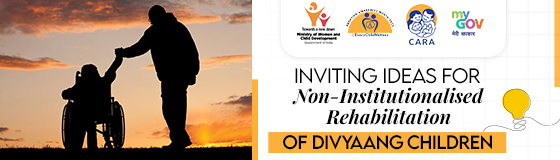
Inviting Ideas for Non-Institutionalised Rehabilitation of Divyaang Children

Inviting Ideas for Non-Institutionalised Rehabilitation of Divyaang Children
आरंभ करने की तिथि :
Oct 01, 2025
अंतिम तिथि :
Nov 30, 2025
17:30 PM IST (GMT +5.30 Hrs)
प्रस्तुतियाँ समाप्त हो चुके

In 2025, the Central Adoption Resource Authority (CARA) is placing special focus on promoting family-based care for children with special needs (Divyaang children). In ...

In 2025, the Central Adoption Resource Authority (CARA) is placing special focus on promoting family-based care for children with special needs (Divyaang children). In collaboration with MyGov, CARA invites all Indian citizens to participate in an important national discussion on the theme:
“Non-institutionalized Rehabilitation of Children with Special Needs (Divyaang Children)”

This initiative seeks to create a collaborative platform where citizens can:
1. Share insights on the challenges and barriers in the identification and adoption of children with special needs
2. Suggest innovative ideas, strategies, or solutions to strengthen the adoption ecosystem
3. Contribute to policy-making by offering actionable recommendations to ensure a loving family environment for every child, especially those currently residing in Specialized Adoption Agencies (SAAs) and Child Care Institutions (CCIs)

Your thoughtful suggestions can play a key role in shaping a more inclusive, compassionate, and efficient adoption framework for Divyaang children.

Who can participate?
All Indian citizens are welcome to join the conversation and submit their ideas.

Why participate?
Selected entries may be featured in national-level publications, exhibitions, and even considered in policy discussions aimed at improving the lives of children with special needs.

Let’s work together to ensure every child finds a loving family and a brighter future. Join the discussion today and be a voice for change!
फिर से कायम कर देना
777 सबमिशन दिखा रहा है
ARITIPALLNITHEESH
ARITIPALLNITHEESH 7 महीने 3 सप्ताह पहले
1.fist child is a Scholl data collate in avery village and moretha percentage child village build school 2. food is provided test is good and lowe cast and higher cast not different same of child 3 ply ground 1day is activeties is provided more. enregytic childern 4.1st class is a energy class we'll be provedde 5.marke is defferent will child not one child anthor child different markes 6.1 class technology and environment knowledge will be provided
subodh bansal
subodh bansal 7 महीने 3 सप्ताह पहले
my post no. 11 Vaccination is root cause cause of autism and ADHD  https://www.facebook.com/share/v/1Cn6WHkazD/ B. हमे दिव्यांग बच्चों को अडॉप्ट करने का क्या फायदा है क्या उपयोगिता है इस पर फोकस करना चाहिए तभी लोग दिव्यांग बच्चों को अडॉप्ट करेंगे फैमिली में।  मेंने post no.5 में ओशो की Born Again Meditation का जिक्र किया है।  This godly gift system may also helpfully to all age people to achieve lost childhood.
sanyog mali
sanyog mali 7 महीने 4 सप्ताह पहले
Gemini Conversation with Gemini Give me some point to discuss on Inviting ideas For non institutionlisted rehabilitation of divyaang Children That's an excellent and crucial topic! Non-institutionalized rehabilitation for Divyaang children (children with disabilities) centers around the Community-Based Rehabilitation (CBR) model, which promotes inclusion within the family and local community. Here are key points to discuss, categorized for a comprehensive conversation: 👨‍👩‍👧‍👦 Family-First & Home-Based Support These points focus on strengthening the child's most immediate environment: the family. Caregiver Empowerment and Training: Shifting the training focus from centralized institutions to local training hubs and home-based programs. Providing 'Caregivers' Trainings' to parents and family members to equip them with specialized skills (e.g., basic physiotherapy, speech therapy techniques, managing behavioral issues). Direct Financial Subsidies and Social Security: Discuss
Mehakahuja
Mehakahuja 7 महीने 4 सप्ताह पहले
truly believe that Divyang children deserve care, respect, and support within their own homes and communities. Many parents wish to help their children but lack proper resources and guidance. If teachers, health workers, and local volunteers are trained to assist them, rehabilitation can become a part of daily life instead of depending only on institutions. Small community centers could provide therapy, learning materials, and counselling. Digital tools and home physiotherapy kits can make a big difference for families. Above all, awareness programs must remind everyone that inclusion is not about sympathy — it is about giving every child an equal chance to learn, grow, and live with dignity. Warm regards, Daksham Ahuja
Mehakahuja
Mehakahuja 7 महीने 4 सप्ताह पहले
truly believe that Divyang children deserve care, respect, and support within their own homes and communities. Many parents wish to help their children but lack proper resources and guidance. If teachers, health workers, and local volunteers are trained to assist them, rehabilitation can become a part of daily life instead of depending only on institutions. Small community centers could provide therapy, learning materials, and counselling. Digital tools and home physiotherapy kits can make a big difference for families. Above all, awareness programs must remind everyone that inclusion is not about sympathy — it is about giving every child an equal chance to learn, grow, and live with dignity. Warm regards, Daksham Ahuja
Tharanika
Tharanika 7 महीने 4 सप्ताह पहले
Namaste everyone🙏 Rehabilitation shouldn’t be limited to big institutions—it starts at home, in schools, and in our communities. Imagine “Community Rehabilitation Hubs” in every district, run by volunteers, parents, and youth, offering therapy, life skills, and emotional support. Schools can be inclusive with trained teachers, buddy systems, and adaptive sports where Divyaang children play alongside others. Technology can help too, with home rehab kits, learning apps, and digital mentorship. Families also need support to shift mindsets from pity to partnership. Disability isn’t inability—it’s just a different ability waiting for opportunity. Let’s build a system where Divyaang children belong everywhere, not just somewhere THANK YOU.