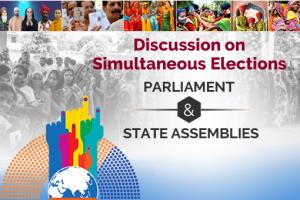
The desirability of holding simultaneous elections for the Lok Sabha and Vidhan Sabhas has been discussed at various levels. A considered view is that simultaneous elections will ...
The desirability of holding simultaneous elections for the Lok Sabha and Vidhan Sabhas has been discussed at various levels. A considered view is that simultaneous elections will not only keep alive the enthusiasm of voters, but will also result in huge savings to the public exchequer as well as avoiding repetition of administrative effort. It is also expected to control the expenses of political parties. Simultaneous elections will also avoid repeated enforcement of the Model Code of Conduct which affects administrative actions by the government.
President of India, His Excellency Shri Pranab Mukherjee has also expressed his views on the desirability of holding simultaneous elections. Speaking at a recent function, The President said that “With some election or the other throughout the year, normal activities of the government come to a standstill because of code of conduct. This is an idea the political leadership should think of. If political parties collectively think, we can change it.... The Election Commission can also put in their idea and efforts on holding the polls together and that will be highly beneficial”
Hon'ble Prime Minister Shri Narendra Modi has spoken several times on considering the feasibility of holding simultaneous Lok Sabha and state assembly elections. In two recent TV discussions, the Prime Minister reiterated this idea and invited a national debate on the issue.
Debate on the Issue - A Brief History
In India, simultaneous elections to the Lok Sabha (House of The People) and Vidhan Sabhas (State Legislative Assemblies) were organized in the years 1951-52, 1957, 1962 and 1967. Thereafter, however, the schedule could not be maintained and the elections to the Lok Sabha and the Vidhan Sabhas have still not been realigned.
The next General Election to the Lok Sabha is scheduled for 2019. Elections for the Vidhan Sabhas of 5 States are scheduled for 2017, for 13 States in 2018, for 9 States in 2019, for 1 State 2020 and the remaining are scheduled for 2021.
The issue of simultaneous elections was debated by the Law Commission in its 107thReport in 1999 (Reform of Electoral Laws) , where in it was mentioned that – “The rule ought to be one election once in five years for Lok Sabha and all Legislative Assemblies” ( Para 7.2.1.1 of the Report). Recently, Parliamentary Standing Committee on Personnel, Public Grievances, Law and Justice presented its 79th Report on ‘Feasibility of holding Simultaneous Elections to the House of People (Lok Sabha) and State Legislative Assemblies’ on 17th December 2015.
Several structural changes will need to be done in case a decision is made to conduct simultaneous election, including possibility of Constitutional amendments to Articles 83, 172, 85 and 174 to streamline the process.
Seventy Ninth Report Parliamentary Standing Committee for PERSONNEL, PUBLIC GRIEVANCES, LAW AND JUSTICEMyGov Discussion
MyGov invites citizens, Parliamentarians, Members of Legislative assemblies and councils, constitutional experts, academics experts, bureaucrats, social media influencers, Think Tanks and all other interested people to give their considered view on the subject. The issues that can be considered while formulating a view are (only an indicative list and not exhaustive):
1. Is it desirable to hold simultaneous elections? What are the pros and cons?
2. If simultaneous elections are held, then for the first time what happens to assemblies whose scheduled tenure either ends before or after the proposed date of holding elections?
3. Should the term of Lok Sabha and assemblies be fixed?
4. What would happen in case by-elections are necessitated in between terms?
5. What happens in case the ruling party or coalition loses majority in between term, either in Lok Sabha or in State assemblies?
You may submit your opinion by either writing in the comment box below, or by attaching a PDF document, or through a Youtube video.
The last for submitting your opinion is 15th October, 2016.
Simulatenous elections will be huge cost savings.it will also end the perennial and continuous process of elections all round the year.. will help govt to focus on development agenda. Sobthe present assemblies may be extended to match with central polls..in case of mid term..common govt mau be formed for rest of term...
It is great suggestion, but will also be dangerous. As all our efforts and strengths will be focused on elections, enemies can take chance on border. Alternate we will not be lucky to have strong leader wave . Some time we will also get strong wave of Idiots. So we need to have elections alternately as happening currently.
It is a very good initiative. Simultaneous elections to state assembly and parliament will save lot of effort and resources on the part of election commission and citizens. All can concentrate on development activities once general elections are complete.
I strongly support Simultaneous elections.
Necessary legislations to be made at the earliest.
There should be a comprehensive rules. A chapter for election in India for Central and States to be drawn and adopted in the Constitution of India. There are so many nations having democracy. We must drawn good provisions and experience from them and discuss it here and a new chapter adopted in the Constitution. Only two parties. A High Power commission to be constituted for drawing election chapter for adopting in the Constitution.
Now there are five questions on simultaneous polls in the States and For Lok sabha. Now 68 years are over after independence. So a new chapter added into constitution. There are so many nations having democracy. We must explore the good provisos. Qualifications, age must be for candidates.The present block,grama and district panchayat to be merged and attached with Village office.No need for Rajya sabha. Elect the Prime Minster directly by the voters. only two parties needed.