
- Chandigarh UT
- Creative Corner
- Dadra Nagar Haveli UT
- Daman and Diu U.T.
- Department of Administrative Reforms and Public Grievances
- Department of Biotechnology
- Department of Commerce
- Department of Consumer Affairs
- Department of Industrial Policy and Promotion (DIPP)
- Department of Posts
- Department of Science and Technology
- Department of Telecom
- Digital India
- Economic Affairs
- Ek Bharat Shreshtha Bharat
- Energy Conservation
- Expenditure Management Commission
- Food Security
- Gandhi@150
- Girl Child Education
- Government Advertisements
- Green India
- Incredible India!
- India Textiles
- Indian Railways
- Indian Space Research Organisation - ISRO
- Job Creation
- LiFE-21 Day Challenge
- Mann Ki Baat
- Manual Scavenging-Free India
- Ministry for Development of North Eastern Region
- Ministry of Agriculture and Farmers Welfare
- Ministry of Chemicals and Fertilizers
- Ministry of Civil Aviation
- Ministry of Coal
- Ministry of Corporate Affairs
- Ministry of Culture
- Ministry of Defence
- Ministry of Earth Sciences
- Ministry of Education
- Ministry of Electronics and Information Technology
- Ministry of Environment, Forest and Climate Change
- Ministry of External Affairs
- Ministry of Finance
- Ministry of Health and Family Welfare
- Ministry of Home Affairs
- Ministry of Housing and Urban Affairs
- Ministry of Information and Broadcasting
- Ministry of Jal Shakti
- Ministry of Law and Justice
- Ministry of Micro, Small and Medium Enterprises (MSME)
- Ministry of Petroleum and Natural Gas
- Ministry of Power
- Ministry of Social Justice and Empowerment
- Ministry of Statistics and Programme Implementation
- Ministry of Steel
- Ministry of Women and Child Development
- MyGov Move - Volunteer
- New Education Policy
- New India Championship
- NITI Aayog
- NRIs for India’s Growth
- Open Forum
- PM Live Events
- Revenue and GST
- Rural Development
- Saansad Adarsh Gram Yojana
- Sakriya Panchayat
- Skill Development
- Smart Cities
- Sporty India
- Swachh Bharat (Clean India)
- Tribal Development
- Watershed Management
- Youth for Nation-Building
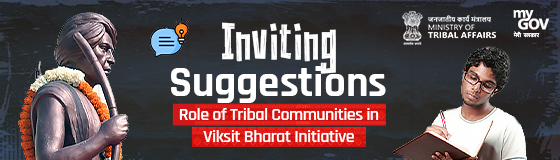
Inviting Suggestions - Role of Tribal Communities in Viksit Bharat Initiative

Start Date :
Jun 15, 2025
Last Date :
Jul 15, 2025
23:45 PM IST (GMT +5.30 Hrs)
As part of the Government of India’s vision for Viksit Bharat (Developed India) by 2047, the Ministry of Tribal Affairs in collaboration with MyGov invites citizens to actively ...
All Comments
Featured
New Comments
Comments (1)
Comments (1)
Showing 560 Submission(s)
BrahmDevYadav
12 months 3 days ago
What are the five most important principles of community development?
Incorporating these five key steps:— community engagement, needs assessment, collaboration, sustainability and evaluation into your community development projects will significantly increase their chances of success.
Like
(0)
Dislike
(0)
Reply
Report Spam
BrahmDevYadav
12 months 3 days ago
What are the seven elements of community development?
1. System Governance. Equal partners keeping the system strong for all neighborhoods.
2. Capacity Building & Certification. Effective, sustainable neighborhood-based organizations.
3. System Capitalization.
4. Neighborhood Voice & Advocacy.
5. Data & Evaluation.
6. Education & Career Pipeline.
7. City Engagement.
Like
(0)
Dislike
(0)
Reply
Report Spam
BrahmDevYadav
12 months 3 days ago
What steps were taken by tribal people to save the forest?
Traditional Forest Management:- Tribal communities have developed traditional forest management practices, such as rotational grazing, controlled burning, and selective harvesting that help to maintain the health and biodiversity of forests.
Like
(0)
Dislike
(0)
Reply
Report Spam
BrahmDevYadav
12 months 3 days ago
What is the role of local communities in the conservation of forests?
In forest conservation, participation is often associated with community forestry, which refers to forest management or co-management by people living close to the forest. Legal, political and cultural settings for community forestry vary widely and the term covers a wide range of experiences and practices.
Like
(0)
Dislike
(0)
Reply
Report Spam
BrahmDevYadav
12 months 3 days ago
What are the features of tribal economy?
The four main sectors of tribal economies in India are agriculture, pastoralism, handicraft making and industrial labour. Agriculture is the predominant contributor to the Indian economy. Agricultural products are traded throughout the country as well as internationally.
Like
(0)
Dislike
(0)
Reply
Report Spam
BrahmDevYadav
12 months 3 days ago
What is the concept of tribal development?
Tribal development in India has been a focus of the national development plans since independence. The constitution provides protections for scheduled tribes and establishes advisory councils and welfare departments to protect tribal rights and promote development.
Like
(0)
Dislike
(0)
Reply
Report Spam
BrahmDevYadav
12 months 3 days ago
What were the roles in ancient tribes?
Generally speaking, men were responsible for hunting, building shelters and making tools. They conducted trade with other tribes, negotiated, and fought when disputes arose. Women were responsible for gathering and growing food, preparing hides and making clothing, pottery and baskets.
Like
(0)
Dislike
(0)
Reply
Report Spam
BrahmDevYadav
12 months 3 days ago
What are the fundamental objectives of community development?
Objective of Community Development Programme:-
They focus on improving the social and economic conditions of rural people. Many programmes seek to reduce poverty and generate employment opportunities in rural areas. They provide skills and resources to improve the livelihoods of the poor.
Like
(0)
Dislike
(0)
Reply
Report Spam
BrahmDevYadav
12 months 3 days ago
What was the role of Birsa Munda in the tribal uprising?
Birsa Munda proclaimed his rebellion in 1894 which was directed against the British and the dikus (outsiders). This is called the Munda Ulgulan. He asked people to stop paying rent and taxes. He also became a religious leader of his people.
Like
(0)
Dislike
(0)
Reply
Report Spam
BrahmDevYadav
12 months 3 days ago
What was the role of tribes in the mediaeval Indian economy?
Tribes were increasingly drawn into the agricultural economy, either as cultivators or laborers. Tribes that resisted integration were often pushed into more inaccessible regions, while others adopted settled agricultural practices.
Like
(0)
Dislike
(0)
Reply
Report Spam
- View More