Home | MyGov

Accessibility
Accessibility Tools
Color Adjustment
Text Size
Navigation Adjustment
Screen Reader iconScreen Reader

Amendments in the Khadi and Village Industries Commission Act, 1956

Amendments in the Khadi and Village Industries Commission Act, 1956
Start Date :
Oct 22, 2025
Last Date :
Nov 22, 2025
17:45 PM IST (GMT +5.30 Hrs)
Submission Closed

To institutionalize the development of the Khadi and Village Industries sector, the Government of India first constituted the All India Khadi and Village Industries Board in 1953. ...

To institutionalize the development of the Khadi and Village Industries sector, the Government of India first constituted the All India Khadi and Village Industries Board in 1953. This was followed by the enactment of the Khadi and Village Industries Commission Act, 1956 (No. 61 of 1956), which inter alia provides for the establishment of the Khadi and Village Industries Commission (KVIC) as a statutory body.

KVIC is entrusted with the responsibility to plan, promote, facilitate, organize, and assist in the establishment and development of Khadi and Village Industries in rural areas, in coordination with other agencies engaged in rural development.

In view of evolving market dynamics, technological advancements, and the need to further strengthen support systems, certain provisions of the KVIC Act, last amended in 2006, require updating. A comprehensive amendment is proposed to align the legislative framework with current sectoral needs and to enhance KVIC’s role as a facilitator of growth, innovation, and sustainable village industries.

To strengthen and modernize the Khadi and Village Industries sector, the Ministry of Micro, Small & Medium Enterprises (MSME) in collaboration with MyGov invites citizens to share their views on the proposed Amendments to the Khadi and Village Industries Commission Act, 1956.

The Ministry of MSME is in the process of amending the KVIC Act, 1956. In this regard, this Ministry is being consulted by various central Ministries/Department. The amendments proposed in the KVIC Act, 1956, are based on the following three key pillars:
(a) Diversification and adoption of New Technology
(b) Formalization of Village Industries
(c) Inclusivity and Institutional Strengthening

(a) Diversification and Adoption of New Technology
(i) Make provision for the adoption of any emerging form of fabric in the KVI Sector.
(ii) Adoption of clean energy, like Solar energy, in Khadi production while retaining the sector's authenticity.

(b) Formalization of Village Industries
(i) Align the "Village Industry" definition with the micro-enterprise classification under the MSME Act, based on investment and turnover thresholds.
(ii) Update the Schedule of Village Industries to allow inclusion of emerging activities aligned with market trends, rural entrepreneurship, and technology-led enterprises.
(iii) To make provisions to facilitate Udyam Registration for village industries and align the Village Industries with the National Industrial Classification Code (NIC Code).

(c) Inclusivity and Institutional Strengthening
(i) To include representation of women, weaker sections (SC/ST/OBC) and contemporary expertise in the Commission’s composition
(ii) To open up the Khadi Sector for new entities.
(iii) To include the rule making power in the functions of the Commission.

Reset
Showing 394 Submission(s)
AANDO G
AANDO G 8 months 6 days ago
The Khadi and Village Industries Commission (KVIC) Act, 1956 governs the functioning of KVIC, which promotes khadi and village industries in India to generate rural employment and boost rural economy. Recent Amendments (Key Highlights): 1. Modernization and Expansion: Amendments aim to modernize the Commission’s functioning and widen its scope to support more village industries, incorporating technological advancements. 2. Enhanced Funding & Support: Provisions for increased financial aid and subsidies to artisans and village industries for better infrastructure and marketing. 3. Digital Initiatives: Encouragement of digital tools and e-commerce platforms to promote khadi products globally. 4. Sustainability & Innovation: Emphasis on eco-friendly, sustainable production methods and innovation in traditional crafts. 5. Governance & Accountability: Improved administrative mechanisms for transparency, accountability, and effective implementation of schemes.
Yogesh Samant
Yogesh Samant 8 months 6 days ago
सर मेरा मानना हे कि किसी गाव मे उद्योग को लगाने से पहले उस गाव के लोगों का कोशल विकास होना जरूरी हे तथा इसे विभिन्न चरणों मे सम्पन किया जा सकता हे 1. उस ग्राम सभा के पलायन करने वाले व्यक्तियों को उस क्षेत्र कि महत्ता के बारे मे जागरूक करना जिससे वर्तमान मे जो युवा पीड़ी सबसे अधिक पलायन कर रही उनकी संख्या मे कमी होगी 2. हर ग्राम सभा में उनके क्षेत्र मे उद्योग कि अनुरूपता के अनुसार कोशल विकास इसके अलावा भी ग्राम स्तर पर कई ओर समस्या हे जिन्हे पूरा करके इन्हे आत्मनिर्भर बनाया जा सकता हे
subodh bansal
subodh bansal 8 months 1 week ago
जबकि वस्त्र और परिधान का कारोबार भारत का 9.3 लाख करोड रुपए है। खादी और ग्राम उद्योग का कारोबार 1.70 लाख करोड़ तक पहुंच गया है 2024 में।   खादी का कारोबार दुगना करने की जरूरत है। नए आइडिया के लिए मुझसे संपर्क करें। 2. खादी को Mall में बेचने का कानून बनाये।  3. खादी को सभी तीर्थ,  मंदिर, टूरिस्ट palace पर बेचने का कानून बनाये।  4. 15 August 26 जनवरी 2 October को सभी खादी पहने।  5. सरकारी कार्यक्रमों में खादी पहनना अनिवार्य।  6. खादी महोत्सव प्रत्येक शहर में मनाये।  7. 5 star hotel, airport, cruise, sea port, bus, rail, taxi, restaurant, resort, staff dress in should खादी। 
Subhash Das
Subhash Das 8 months 1 week ago
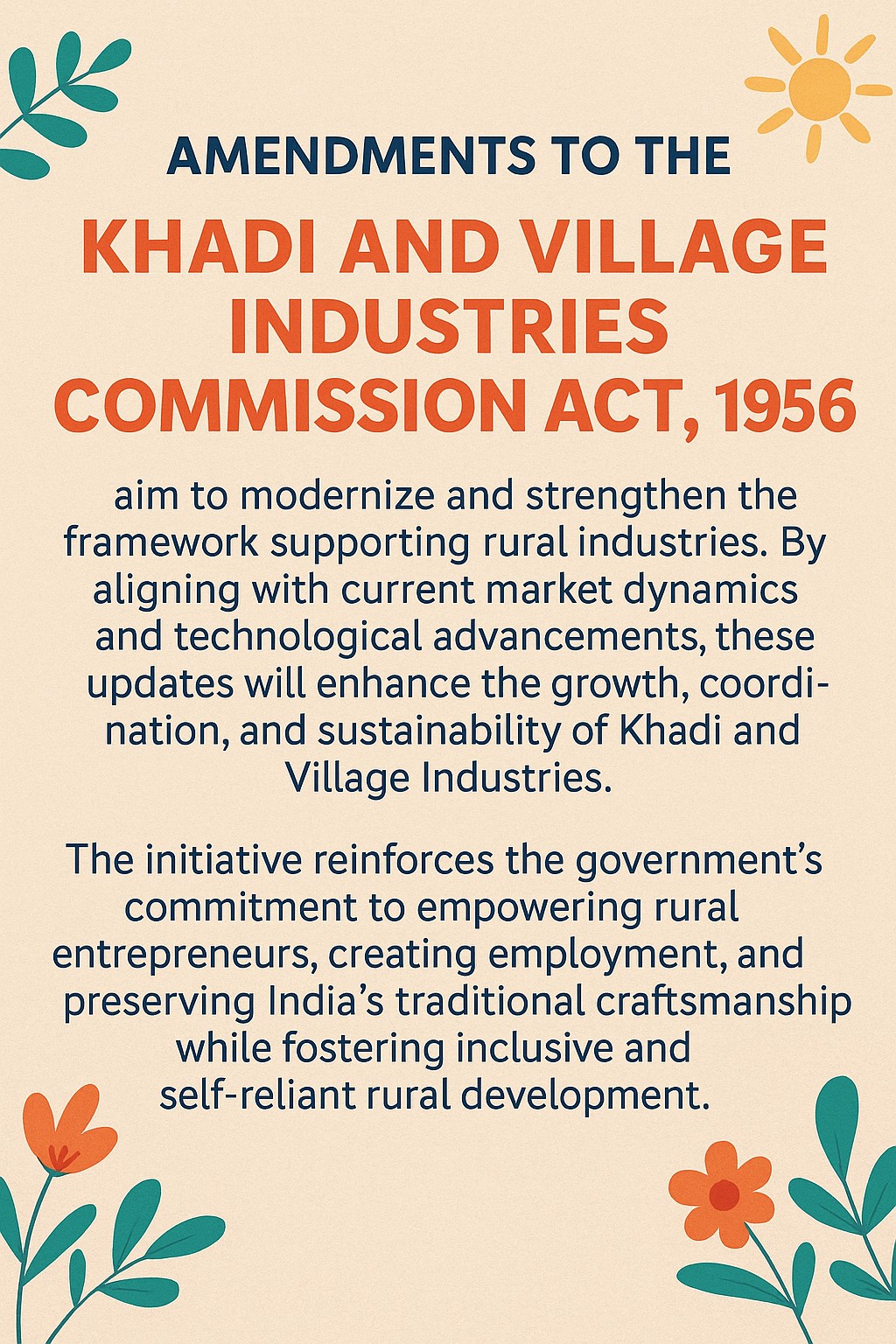
The proposed amendments to the Khadi and Village Industries Commission Act, 1956 aim to modernize and strengthen the framework supporting rural industries. By aligning with current market dynamics and technological advancements, these updates will enhance the growth, coordination, and sustainability of Khadi and Village Industries. The initiative reinforces the government’s commitment to empowering rural entrepreneurs, creating employment, and preserving India’s traditional craftsmanship while fostering inclusive and self-reliant rural development.
mygov_176139806887210751
Subhash Das
Subhash Das 8 months 1 week ago
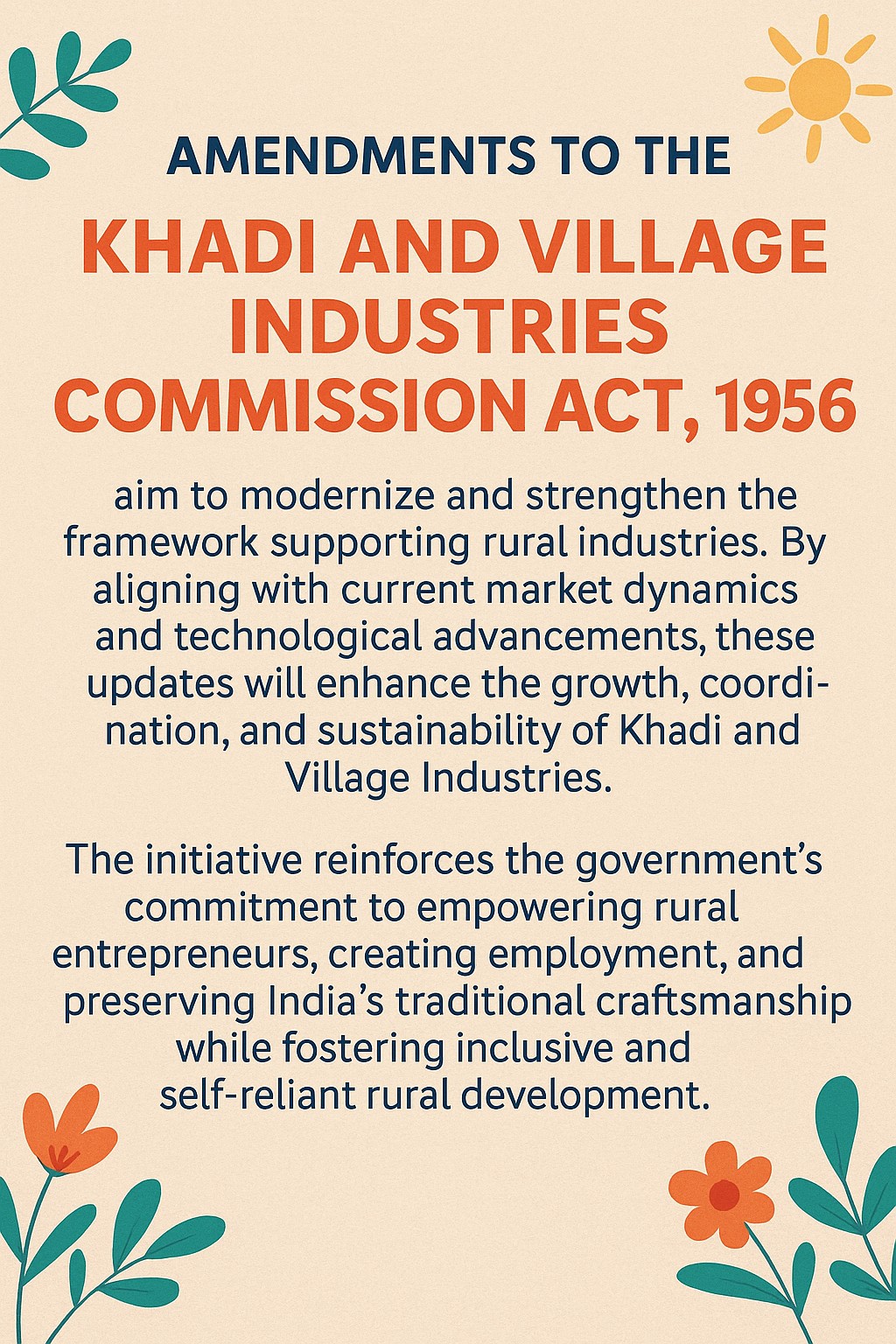
The proposed amendments to the Khadi and Village Industries Commission Act, 1956 aim to modernize and strengthen the framework supporting rural industries. By aligning with current market dynamics and technological advancements, these updates will enhance the growth, coordination, and sustainability of Khadi and Village Industries. The initiative reinforces the government’s commitment to empowering rural entrepreneurs, creating employment, and preserving India’s traditional craftsmanship while fostering inclusive and self-reliant rural development.
mygov_176139800787210751
Subhash Das
Subhash Das 8 months 1 week ago
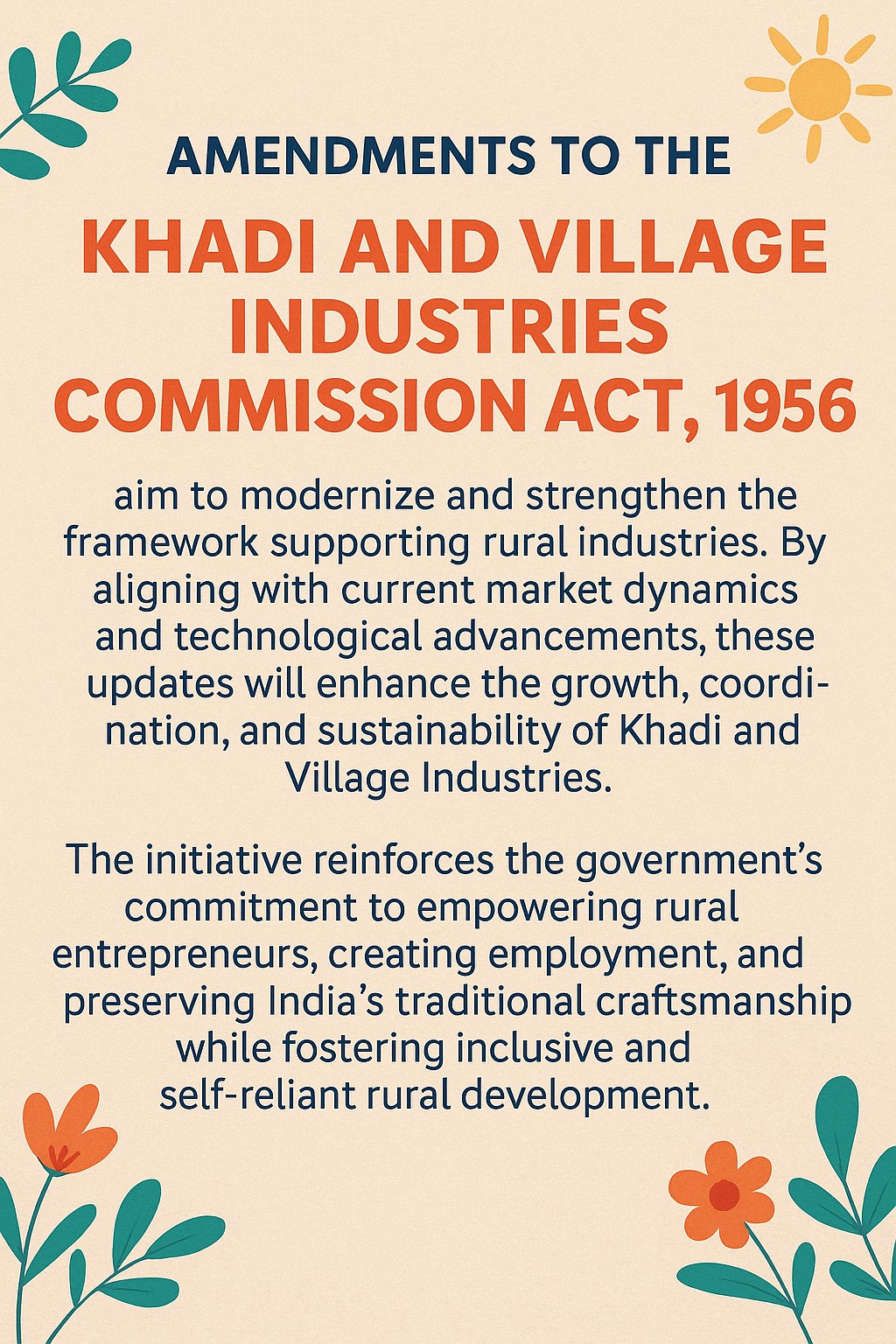
The proposed amendments to the Khadi and Village Industries Commission Act, 1956 aim to modernize and strengthen the framework supporting rural industries. By aligning with current market dynamics and technological advancements, these updates will enhance the growth, coordination, and sustainability of Khadi and Village Industries. The initiative reinforces the government’s commitment to empowering rural entrepreneurs, creating employment, and preserving India’s traditional craftsmanship while fostering inclusive and self-reliant rural development.
mygov_176139796787210751
Subhash Das
Subhash Das 8 months 1 week ago
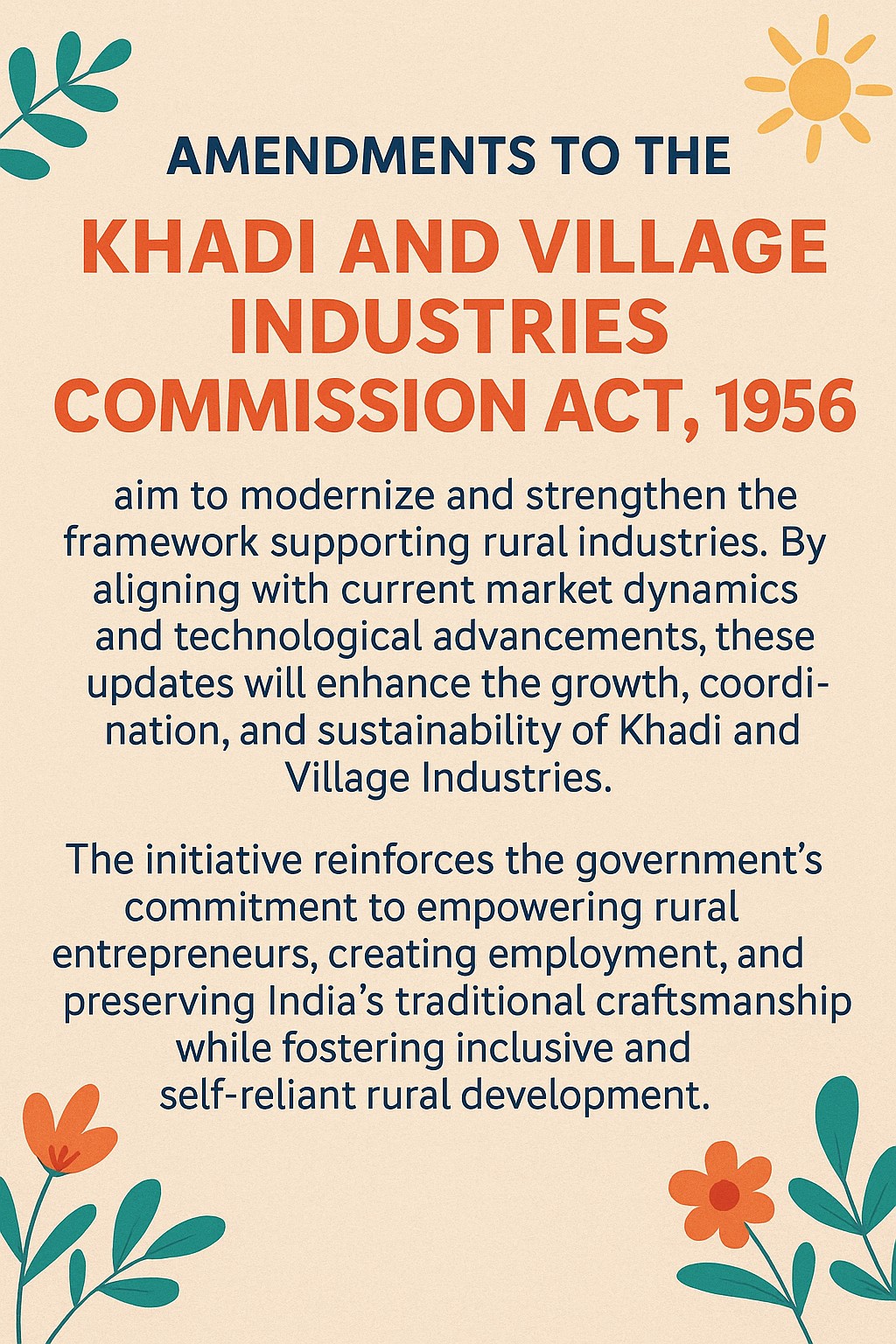
The proposed amendments to the Khadi and Village Industries Commission Act, 1956 aim to modernize and strengthen the framework supporting rural industries. By aligning with current market dynamics and technological advancements, these updates will enhance the growth, coordination, and sustainability of Khadi and Village Industries. The initiative reinforces the government’s commitment to empowering rural entrepreneurs, creating employment, and preserving India’s traditional craftsmanship while fostering inclusive and self-reliant rural development.
mygov_176139790387210751
George
George 8 months 1 week ago
Towards the objective of enabling and facilitating Corporations to support Micro Industries through CSR funds. The act to provide for the same. The act provides for a framework, such as an audit framework. This enables a corporation to support such a microenterprise or cooperative. To incur expenses towards supporting the Khadi & village industry sector directly or through an NGO. Activities such as commissioning designers, R&D on technology, funding eMarket websites, Marketing, including incurring the cost to send artisans & their wares to overseas or metros.