Home | MyGov

Accessibility
Accessibility Tools
Color Adjustment
Text Size
Navigation Adjustment
Screen Reader iconScreen Reader

Amendments in the Khadi and Village Industries Commission Act, 1956

Amendments in the Khadi and Village Industries Commission Act, 1956
Start Date :
Oct 22, 2025
Last Date :
Nov 22, 2025
17:45 PM IST (GMT +5.30 Hrs)
Submission Closed

To institutionalize the development of the Khadi and Village Industries sector, the Government of India first constituted the All India Khadi and Village Industries Board in 1953. ...

To institutionalize the development of the Khadi and Village Industries sector, the Government of India first constituted the All India Khadi and Village Industries Board in 1953. This was followed by the enactment of the Khadi and Village Industries Commission Act, 1956 (No. 61 of 1956), which inter alia provides for the establishment of the Khadi and Village Industries Commission (KVIC) as a statutory body.

KVIC is entrusted with the responsibility to plan, promote, facilitate, organize, and assist in the establishment and development of Khadi and Village Industries in rural areas, in coordination with other agencies engaged in rural development.

In view of evolving market dynamics, technological advancements, and the need to further strengthen support systems, certain provisions of the KVIC Act, last amended in 2006, require updating. A comprehensive amendment is proposed to align the legislative framework with current sectoral needs and to enhance KVIC’s role as a facilitator of growth, innovation, and sustainable village industries.

To strengthen and modernize the Khadi and Village Industries sector, the Ministry of Micro, Small & Medium Enterprises (MSME) in collaboration with MyGov invites citizens to share their views on the proposed Amendments to the Khadi and Village Industries Commission Act, 1956.

The Ministry of MSME is in the process of amending the KVIC Act, 1956. In this regard, this Ministry is being consulted by various central Ministries/Department. The amendments proposed in the KVIC Act, 1956, are based on the following three key pillars:
(a) Diversification and adoption of New Technology
(b) Formalization of Village Industries
(c) Inclusivity and Institutional Strengthening

(a) Diversification and Adoption of New Technology
(i) Make provision for the adoption of any emerging form of fabric in the KVI Sector.
(ii) Adoption of clean energy, like Solar energy, in Khadi production while retaining the sector's authenticity.

(b) Formalization of Village Industries
(i) Align the "Village Industry" definition with the micro-enterprise classification under the MSME Act, based on investment and turnover thresholds.
(ii) Update the Schedule of Village Industries to allow inclusion of emerging activities aligned with market trends, rural entrepreneurship, and technology-led enterprises.
(iii) To make provisions to facilitate Udyam Registration for village industries and align the Village Industries with the National Industrial Classification Code (NIC Code).

(c) Inclusivity and Institutional Strengthening
(i) To include representation of women, weaker sections (SC/ST/OBC) and contemporary expertise in the Commission’s composition
(ii) To open up the Khadi Sector for new entities.
(iii) To include the rule making power in the functions of the Commission.

Reset
Showing 394 Submission(s)
Sabirul Islam
Sabirul Islam 7 months 4 weeks ago
I am submitting a proposal suggesting key amendments in the Khadi and Village Industries Commission Act, 1956, focused on rural empowerment, digitalization, and eco-friendly production. Kindly find my detailed proposal attached as a PDF for your kind review.
Abhishek Bairwa
Abhishek Bairwa 7 months 4 weeks ago
Khadi is an iconic Indian hand-spun, hand-woven fabric that holds immense cultural and economic value, primarily supporting artisans and village industries. To increase its usage among Indians and make it a sustainable business, a two-pronged strategy is essential: boosting demand through modernization and ensuring affordability via subsidies. Government bodies like KVIC are working with fashion institutes to create contemporary, youth-friendly designs to make Khadi fashionable, while simultaneously providing schemes like the Modified Market Development Assistance (MMDA). This MMDA scheme helps reduce the market price of Khadi for consumers while providing financial incentives to the artisans and institutions, ensuring that Khadi remains a viable and growing industry for Indian businesses and a proud wardrobe choice for the nation.
jose k a
jose k a 7 months 4 weeks ago
Hi Modi ji Khadi is an iconic Indian hand-spun, hand-woven fabric that holds immense cultural and economic value, primarily supporting artisans and village industries. To increase its usage among Indians and make it a sustainable business, a two-pronged strategy is essential: boosting demand through modernization and ensuring affordability via subsidies. Government bodies like KVIC are working with fashion institutes to create contemporary, youth-friendly designs to make Khadi fashionable, while simultaneously providing schemes like the Modified Market Development Assistance (MMDA). This MMDA scheme helps reduce the market price of Khadi for consumers while providing financial incentives to the artisans and institutions, ensuring that Khadi remains a viable and growing industry for Indian businesses and a proud wardrobe choice for the nation.
Rajeshwari Aher
Rajeshwari Aher 7 months 4 weeks ago
First of all industries are very important to all of uss. This includes youngsters mainly. Today many people are unemployed if the industries grow the employment will increase. Personally I think we should make job opportunity easier
PRAHALAD MUNDARI
PRAHALAD MUNDARI 7 months 4 weeks ago
Yes 😊, industries are good in many ways — they help a country grow and provide jobs. Here are a few good effects of industries 👇 1. Provide employment to many people. 2. Increase production of goods. 3. Help in economic growth of the country. 4. Improve standard of living. 5. Promote trade and commerce. 6. Encourage development of new technology. 7. Help in urbanization (growth of cities). 8. Support transport and communication development. 9. Bring foreign exchange through exports. 10. Help in reducing poverty. Would you like me to also write the bad effects of industries (like pollution, etc.) for comparison?
Naman Tiwari
Naman Tiwari 7 months 4 weeks ago
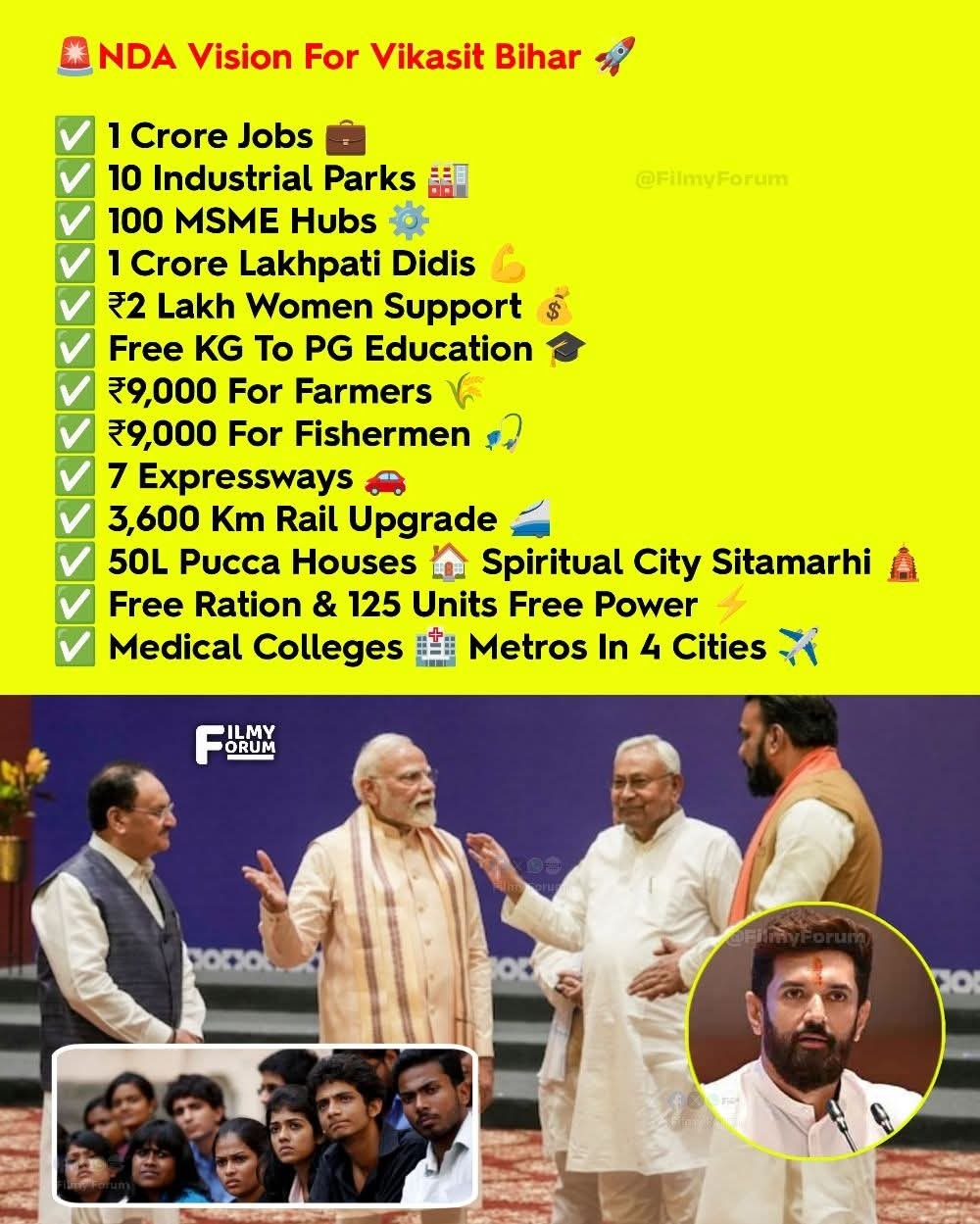
there is one attachment of your manifesto of your bihar election & one attachment of my plan of how it will be successfully implemented.their is also a political benefit for future prospective
mygov_176197153437912924
mygov_176197158537912924
DEVIPRASAD THIMMAIAH THOTAMBAILU
DEVIPRASAD THIMMAIAH THOTAMBAILU 7 months 4 weeks ago
Honorable PM Dear Modi, Bring back garments stitching back to village homes from Garment factories. this will give crores of jobs across country. garment industries actually killed Tailors across country. we need to upgrade to new technology, new ways of dress and eassy way of life . 1000 years old culture should have been uograded day by day . today what is eassy and user friendly shall be culture. way to improve , adopt Sustain then again improve adopt and sustain shall be the slogan not sticking to 500 years old culture. Bharathwasis shall upgrade the standard of living with eassy way of garments and not sticking to ego set on culture. culture itself is becoming costlier when days pass be so we need to adopt to new less cost way of dress. thanks DP